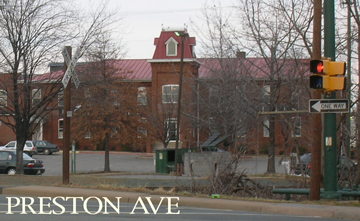
How many times have you driven by the county office buildings/Bodo’s on Preston and wondered what the Gothic-looking mansion was originally ? 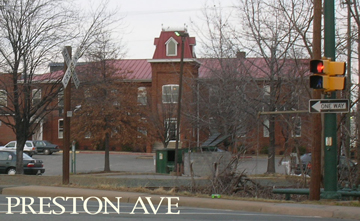 I’m referring to the H.C. Marchant Manufacturing Company. In a 1906 “illustrated edition” of the Daily Progress, the plant is described as “devoted exclusively to the manufacture of overalls and coats of every grade.” Amazingly, the building contained 6,325 square feet of office space and originally employeed 75 workers. Alas, the article concluded that “the future of this company is undoubtedly assured.” While that does not appear to be the case, it’s admirable that their motto was “No Skimping,” with an emphasis on the “best material,” “full cut,” and “honest make.”
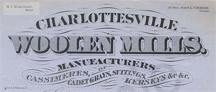
I’m pretty certain that the owner of the building is the same Henry C. Marchant who owned the mill in Woolen Mills. To the right is an example of their letterhead (from a letter dated 1878). H.C. Marchant’s name and title “President” is highlighted in the upper left-hand corner and the advertisement promises “cassimeres (sic), cadet grays, suitings, Kerseys, etc. etc.” Does anyone know what a Kersey is ?